Average Reviews:

(More customer reviews)I was excited to read this, because I love Cook's Illustrated (of which Kimball is the founder) and I thought food history plus Cook's Illustrated would be neat. Unfortunately, it didn't live up to my expectations.
First, the book is positioned as a tribute to Fannie Farmer, yet Kimball has no respect for her. He refers to her constantly as not much of a cook, but as a great businesswoman. He calls her "middle class at best". He denies her claim to being "the mother of level measurements" based on little more evidence than his feeling that the claim is "apocryphal". And he just flat-out doesn't like her recipes.
Kimball not only rewrites the recipes he does use (which I was expecting), he often goes and uses some other recipe entirely: for example, the lobster l'Americaine is based on Gordon Ramsay's recipe. Fannie Farmer's cake recipes are "rather uninspired", so off he goes to an 1888 French cake book for Mandarin Cake instead. The subtitle ought to be "Creating One Amazing Meal from a Couple of Recipes in Fannie Farmer's 1896 Cookbook and Lots of Other Recipes I Like More". A lot of the recipes do look good, but making a bunch of non-Fannie Farmer recipes is simply not what the book claims to be about.
Kimball may be a good cook, but he's clearly not much of a historian. Each chapter begins with a little historical essays on some aspect of 19th-century cooking, Fannie Farmer, or Boston generally. The essays are disorganized and packed full of unrelated factoids; often the entire essay has little or nothing to do with the rest of the chapter. Why do we need to read three pages on Boston clubs, for instance (other than to find out that Kimball belongs to one)? Every once in a while he would hit on a pertinent topic, like Boston farmers' markets, and I would read those with interest, but even these bits often devolved into long paragraphs of factoids, unconnected facts, and unwarranted assumptions.
But the worst thing about these historical discourses is that Kimball seems to have very little real sense of the period he's writing about. If he doesn't understand it, he thinks it's silly; if their taste is different from ours, it's bad taste; if it's something that doesn't fit into his view of the period (such as their interest in hygiene and chemistry), it's surprisingly "modern". He mocks an early recipe for Indian pudding as "silly" because it directs the cook to let the molasses drop in while singing a verse of "Nearer My God to Thee" (in cold weather, sing two verses). Does he not understand that in an era without measuring spoons or kitchen timers, this is a perfectly reasonable way of measuring molasses?
As I said, I did find some passages interesting, and the recipes are certainly fun to read, so it's not all bad. For me, though, the parts I liked were far outweighed by the parts I didn't.
Click Here to see more reviews about: Fannie's Last Supper: Re-creating One Amazing Meal from Fannie Farmer's 1896 Cookbook
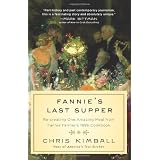
In the mid-1990s, Chris Kimball moved into an 1859 Victorian townhouse on the South End of Boston and, as he became accustomed to the quirks and peculiarities of the house and neighborhood, he began to wonder what it was like to live and cook in that era. In particular, he became fascinated with Fannie Farmer's Boston Cooking-School Cook Book. Published in 1896, it was the best-selling cookbook of its age--full of odd, long-forgotten ingredients, fascinating details about how the recipes were concocted, and some truly amazing dishes (as well as some awful ones).In Fannie's Last Supper, Kimball describes the experience of re-creating one of Fannie Farmer's amazing menus: a twelve-course Christmas dinner that she served at the end of the century. Kimball immersed himself in composing twenty different recipes--including rissoles, Lobster à l'Américaine, Roast Goose with Chestnut Stuffing and Jus, and Mandarin Cake--with all the inherent difficulties of sourcing unusual animal parts and mastering many now-forgotten techniques, including regulating the heat on a coal cookstove and boiling a calf's head without its turning to mush, all sans food processor or oven thermometer. Kimball's research leads to many hilarious scenes, bizarre tastings, and an incredible armchair experience for any reader interested in food and the Victorian era.
Fannie's Last Supper includes the dishes from the dinner and revised and updated recipes from The Boston Cooking-School Cook Book. A culinary thriller. it offers a fresh look at something that most of us take for granted--the American table.
Praise for Fannie's Last Supper
"Chris's `Fannie' project is the most ambitious cooking undertaking I've ever witnessed outside of a restaurant opening. And as one of the devourers of the ultimate meal, I can tell you it was worth it, at least for me. (I would travel 200 miles for the jellies alone.) But the account of the making of the meal, told here in winning style, is just as impressive: part history and part contemporary journalism, it's a fascinating story, and absolutely unique." --Mark Bittman, author of How to Cook Everything
"What a piece of work Christopher Kimball has pulled off. Read this book and join the escapade into what Chris calls the most progressive era in the history of the world. No, it wasn't ten years ago, it was 110 years ago--the world of Victorian America and Fanny Farmer. Not an iota of dreamy pseudo-food history survives here. Instead, Chris challenges, provokes, entertains, and maybe even outrages our sensibilities. One thing is sure, if he gets his way, you will be rethinking some of today's accepted political culinary wisdom."--Lynne Rossetto Kasper, host of The Splendid Table
"Fannie's Last Supper is a splendid book with recipes and narrative that is based on a twelve-course dinner right out of the back pages of the original 1896 Boston Cooking-School Cook Book written by Fannie Farmer. How fantastic is that--traveling back in time to rethink the cooking of the future. A great, informative read with tempting recipes. Bravo!" --Lidia Bastianich, author of Lidia Cooks from the Heart of Italy
"A dynamic and entertaining book for chefs and home cooks alike. Christopher Kimball delves into the life, times, and recipes of Fannie Farmer, and creates an educational and delicious twelve-course menu that any food lover can sink their teeth into."--Daniel Humm, Executive Chef, Eleven Madison Park
 Get 34% OFF

0 comments:
Post a Comment